
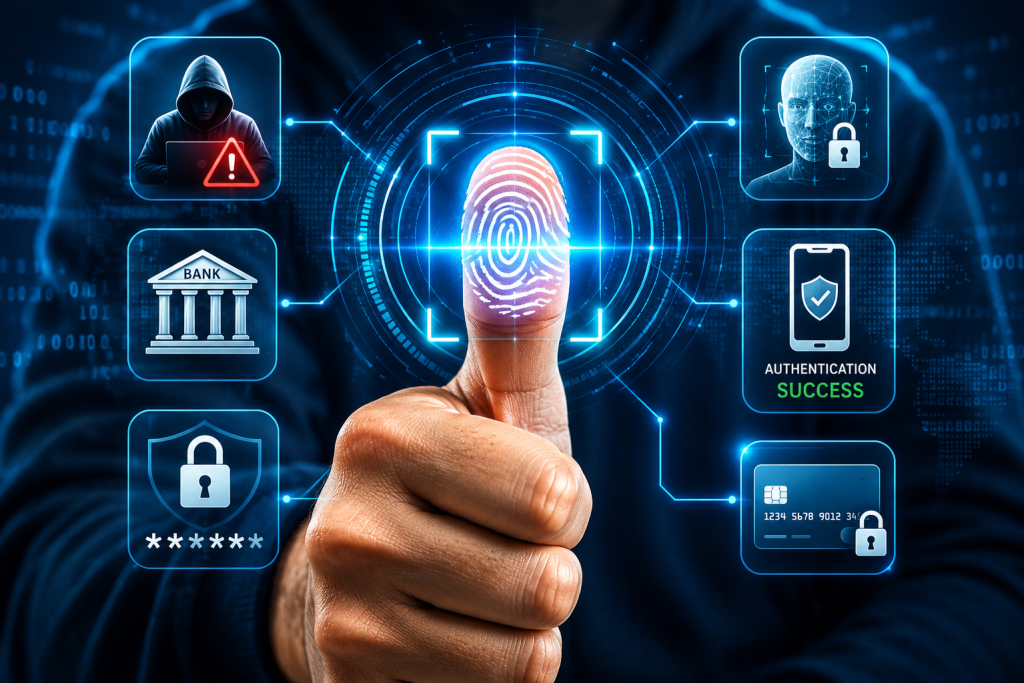
AI Is Changing the Rules of Identity Security
For years, fingerprint authentication has been promoted as one of the safest and most convenient ways to secure smartphones, banking applications, and online transactions. A simple touch of a finger can unlock devices, approve payments, and verify identities in seconds.
However, a recent report by Impact Newswire highlights a growing concern among cybersecurity experts: advances in artificial intelligence may be making biometric data, including fingerprints, more vulnerable than ever before.
Why Fingerprints Are Different From Passwords
Unlike passwords, fingerprints cannot be changed. If a password is stolen, users can create a new one. When biometric data is compromised, there is no reset button.
Security specialists warn that AI technologies are becoming increasingly capable of reconstructing biometric information from partial images, leaked databases, and digital templates. This creates a potentially long-term security risk for individuals and organizations that rely heavily on fingerprint-based authentication.
How AI Could Be Exploited
According to the report, researchers have demonstrated that fingerprints can sometimes be recreated from high-resolution photographs or fingerprints left on surfaces. Machine learning tools can enhance incomplete prints and generate synthetic versions that may be used in certain spoofing attacks. [impactnews-wire.com]
At the same time, generative AI and deepfake technologies are expanding the threat landscape. Cybercriminals can potentially combine stolen biometric information with AI-generated identities, creating sophisticated attacks aimed at bypassing security systems.
The Convenience vs. Security Dilemma
Biometric authentication has become a standard feature in mobile banking, digital payments, border control systems, and enterprise security. While these technologies offer undeniable convenience, experts caution that greater adoption also means greater exposure.
The challenge for organizations is balancing user experience with stronger security controls. As biometric systems become more widespread, attackers are dedicating more resources to finding ways around them.
What Security Experts Recommend
Rather than relying solely on a fingerprint, cybersecurity professionals increasingly recommend multi-factor authentication (MFA). This can include:
- Fingerprint verification combined with a PIN or password
- Device-based authentication
- Behavioral analysis
- Liveness detection technologies
- One-time security codes
Layering multiple security measures makes it significantly harder for attackers to gain unauthorized access, even if biometric data has been compromised.
What This Means for Consumers
If you currently authorize financial transactions using only your fingerprint or thumbprint, it may be worth reviewing your security settings.
Consider enabling additional authentication methods wherever possible, especially for banking, investment, and business accounts. While biometrics remain useful and convenient, experts suggest they should no longer be viewed as a standalone security solution.
Final Thoughts
Artificial intelligence continues to deliver remarkable innovations, but it is also transforming the cybersecurity landscape. The same technology that improves digital experiences can also be used to exploit weaknesses in identity systems.
As the threat environment evolves, businesses and consumers alike should rethink how they protect sensitive information. In the age of AI, security is no longer about a single layer of protection—it is about creating multiple barriers that keep your identity safe.
Source: Inspired by reporting from Impact Newswire’s article, “AI is Stealing Your Fingerprints, Stop Authorising Transactions With Your Thumb” (19 May 2026). [impactnews-wire.com]